Types of Love Addiction Explained: What to Know

You can heal from love addiction to find a fulfilling relationship. Read on to learn more about love addiction types compared with healthy relationships.
Hi, I’m Michele Ross LCSW, an addiction therapist in Los Angeles. I specialize in supporting individuals in recovery from love addiction.
There is no single definition of love addiction, and it is not currently recognized as a diagnosable disorder. However, the symptoms that one experiences are real.
Research into love addiction can help explain the attachment wounds, anxiety, compulsions, and trauma that often shape these patterns.
Love addiction can show up in different ways. Some people stay in relationships because they fear being alone, while others fear intimacy and pull away when love becomes too close. Others are drawn to the rush of new romance and struggle to stay grounded once the honeymoon phase fades.
Because love addiction exists on a spectrum, the way people cope can look very different from one person to the next.
In this article, you’ll learn about the main types of love addiction, the research behind them, and the common causes that may contribute to each pattern.
What is Love Addiction (General Definition)
Love addiction looks different from secure, grounded, healthy love.
Instead of creating a sense of safety and connection, a relationship dependence can pull someone into a situation that is obsessive, draining, or harmful. It can also drive a person toward unavailable partners who are difficult to reach emotionally.
Love addiction symptoms include:
Preoccupation the relationship in a way that hinders daily life
Low self-esteem
Withdrawal from friendships, activities, and work
High anxiety about a partner and the relationship
Heightened discomfort when not physically with your partner
Unreasonable behavior, such as spending large sums of money, tracking your partner via apps, or constant texting.
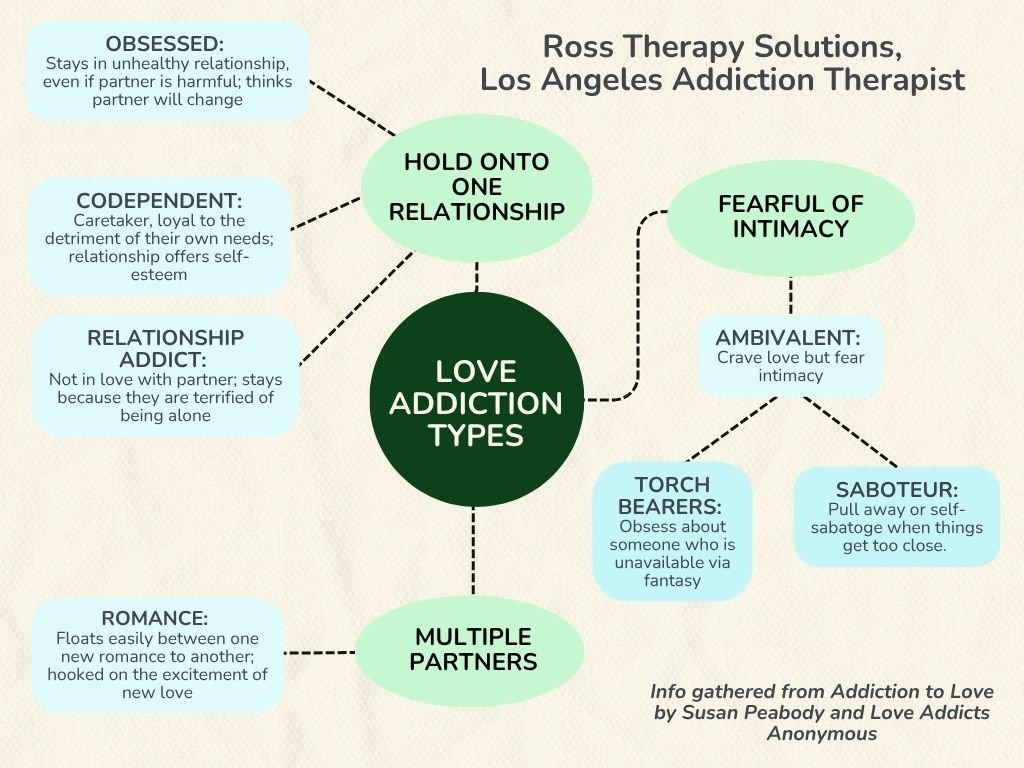
A chart showing the similarities and differences between the different love addiction types
Types of Love Addiction:
In this article, we will talk about three main groups of love addiction, and the subgroups within each type.
Love Addiction Where An Individual Holds onto One Relationship
Obsessed Love Addiction
Codependent Love Addiction
Relationship Addict
Love Addiction That is Fearful of Intimacy (Ambivalent)
Torch Bearers
Saboteurs
Love Addiction Through Multiple Partners
Romance Addiction
Love Addiction Where An Individual Holds Onto One Relationship
Three different subtypes of love addiction can show up when someone stays in a single relationship, where there is a core fear of being alone.
These patterns were first outlined by Susan Peabody in Addiction to Love.
Many of these behaviors are linked to an anxious or preoccupied attachment style. In some cases, this fear of abandonment can be traced back to inconsistent caregiving or emotional neglect in childhood
(Love Addicts Anonymous, Addiction Center).
Obsessive Love Addiction
Someone with obsessive love addiction stays in a relationship that is clearly unhealthy, even when the warning signs are obvious to others.
They may:
Remain in a toxic or harmful relationship
Ignore repeated red flags like cheating, anger, or emotional abuse
Believe their partner will eventually change, without real accountability
The “obsessive” part comes from how intensely they fixate on their partner. They often idealize them, despite clear issues, and may abandon their own hobbies, friendships, or routines to focus entirely on the relationship.
Research shows that love addiction can create “significant suffering and harm,” and may even mirror substance addiction in its intensity (pmc).
What separates this from a healthy relationship is the cost of the obsession. In a healthy dynamic, it’s normal to have a depth of love for your partner, miss them when they’re away, or feel happy around them. For the love addict, any type of absence in the relationship can become intolerable . This can be activated by trips, being out with friends or family or even by lack of response by text.
2. Codependent Love Addiction
Codependency is when a person’s self-worth is tied to taking care of a partner.
A codependent person may:
Stay loyal at the expense of their own needs
Constantly give, support, or “rescue” their partner
Feel valuable only when they are needed
In these relationships, there is often a consistent imbalance. One partner gives and enables, while the other mostly takes. This pattern is closely tied to emotional dependency (PMC study; Pathological Altruism research).
Codependent behavior can develop in childhood environments where the individual took on a caregiving role early. If their value was tied to “helping” or fixing others, that pattern can carry into adult relationships (Tennessee Detox Center).
In a healthy relationship, support goes both ways. The balance may shift one way or another over time, but it is mutual and grounded in accountability. The self-esteem of either individual is not entirely dependent on being needed, and the relationship is not their only source of identity or fulfillment.
3. Relationship Addict
A relationship addict is not necessarily in love anymore, but they stay anyway.
They may:
Feel emotionally disconnected from their partner
Stay in the relationship out of fear of being alone
Only feel secure or worthy when they are in a relationship
For this person, losing the relationship feels like losing stability, identity, and self-esteem. Often, their feelings are linked to anxious attachment and early experiences of abandonment.
Studies show a strong connection between low self-esteem and fixation on romantic relationships (PMC study).
In a healthy relationship, both partners genuinely feel love and connection. While challenges and conflicts happen, there is still an underlying sense of care and emotional bond that keeps the relationship grounded.
Types of Love Addiction with a Fear of Intimacy
A fear of intimacy can sometimes also be called avoidant love addiction. It may be confusing at first to consider someone who is avoiding love as an addict. But at its core, love addiction is about the unhealthy emotional patterns in relationships.
This avoidance of intimacy may point to an avoidant attachment style, possibly as a response to narcissistic parents, early emotional wounding, or abandonment.
Ambivalent Love Addiction
Ambivalent love addiction is the overarching category for people who crave love, but deeply fear intimacy. This fear prevents the formation of secure, healthy relationships.
Within the ambivalent type, there are two common subtypes:
Torch bearers, who fixate on a single person who is emotionally or physically unavailable. The rejection or absence of the person may even fuel the obsession (pmc). They live in the fantasy of unobtainable love, which prevents them from finding true connection with available partners.
Saboteurs will date others, but pull away the second things become too serious. They may create conflict, lose interest suddenly, or find reasons to leave. This self-sabotage allows them to stay in control and avoid the possibility of rejection or abandonment.
Intimacy is an integral part of a healthy relationship. While many may see intimacy as being another word for sex, it also goes beyond that. Balanced intimacy can be a model for healthy attachment, where a sense of closeness and connection is felt due to trusting the other person and feeling understood (PsychCentral).
Types of Love Addiction with Multiple Partners
Romance Addiction (also called relationship addiction)
Romance addiction is sometimes described as a form of relationship addiction.
A person with romance addiction may:
thrive on the newness of a relationship
be chasing the “high” of the honeymoon phase
They may move quickly from one romance to the next, or see multiple people at once, chasing the emotional high of early attraction. When the relationship’s initial spark fades, they can lose interest and look for a new person for a new rush.
This is different from a healthy relationship, where the early intensity naturally softens over time and is replaced by deeper intimacy, trust, and connection.
Therapy for Healthier Relationships
As a therapist specializing in love addiction, I help clients build healthier relationships in the present while healing the old wounds and coping patterns that often come from trauma.
When you work with a therapist, you can develop a stronger sense of self and more confidence. Then, love feels secure instead of anxious, codependent, or driven by fear.
Contact me for a free 15-minute consultation to explore what life could look like with more security, balance, and self-trust in your relationships.
Sessions are available in my Larchmont office or online for California residents.
