Compulsive Buying-Shopping Disorder: Why it’s hard to stop yourself
Hi, I’m Michele Ross LCSW, an addiction therapist in Los Angeles. I specialize in supporting individuals with behavioral addictions like compulsive buying.
If you’re ready for support, the easiest next step is to reach out to me on my short contact form.

If you are a compulsive buyer, this may feel familiar: You’re scrolling on TikTok, you see one of your favorite influencers talking about an item that they love, with a link to buy it directly from them at a 15% discount.
Your decision process suddenly speeds up. You see the item, the discount, and the influencer’s endorsement all at once. Your body feels a rush as you look for the “buy” button. The internal ‘go’ signal builds so quickly that stopping it can feel almost impossible.
After the purchase, you feel ashamed. You’re an intelligent person, and normally self-aware. Why does it feel like that part of you disappears in the moment?
It can be hard to stop this fast reaction for long enough to reflect on the decision, even if you want to. There may be limited opportunity for your ‘thinking it through’ system to engage before you’re already made the purchase (Science Direct, FrontiersIn).
The quickness is reinforced by our ease of access to mobile shopping, social media, and one-click buying.
Although you may not be compulsive in other parts of your life, buying things, especially when you know you don’t need it or it’s not a good financial decision falls into the category of addiction and obsessive compulsive behavior.
Part of this is due to the multi-layered components of shopping addiction.
Compulsive Shopping and the Brain
To understand why these urges are so powerful, it helps to look at what’s happening in the brain.
Systematic reviews suggest that shopping disorder shares features with:
behavioral addictions
OCD-spectrum traits
and impulse control difficulties
(FrontiersIn).
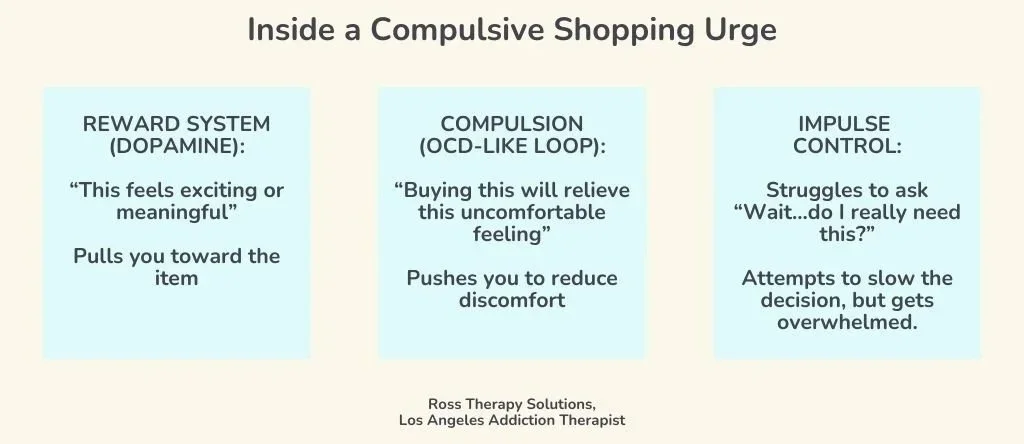
These overlaps paint a picture for the difficulties people face when trying to overcome compulsive shopping.
At the moment you see a shopping trigger, three things can happen at once:
The reward system (dopamine) & behavioral addiction: draws you toward the item because it feels exciting or meaningful.
The compulsion process & OCD: drives you to buy to reduce stress, boredom, or discomfort.
Impulse control process: struggles to slow the decision down or consider consequences.
Compulsive shopping doesn’t always come from one single force. There can be an overlap of “wanting,” “escaping,” and “thinking” competing in real time.
Dopamine-driven Anticipation in CBSD
The dopamine reward system helps the brain assign importance to certain triggers and inspires action. This system can be connected to the behavioral addiction side of compulsive buying.
It’s often assumed that the item purchased is the reward in shopping compulsion.
However, research suggests that it can be linked to anticipation activities and the dopamine signals they cause. These anticipatory activities include browsing, imagining ownership, and deciding to purchase.
A simple restock notification can seem minor on the surface, but this can cue the reward cycle to begin.
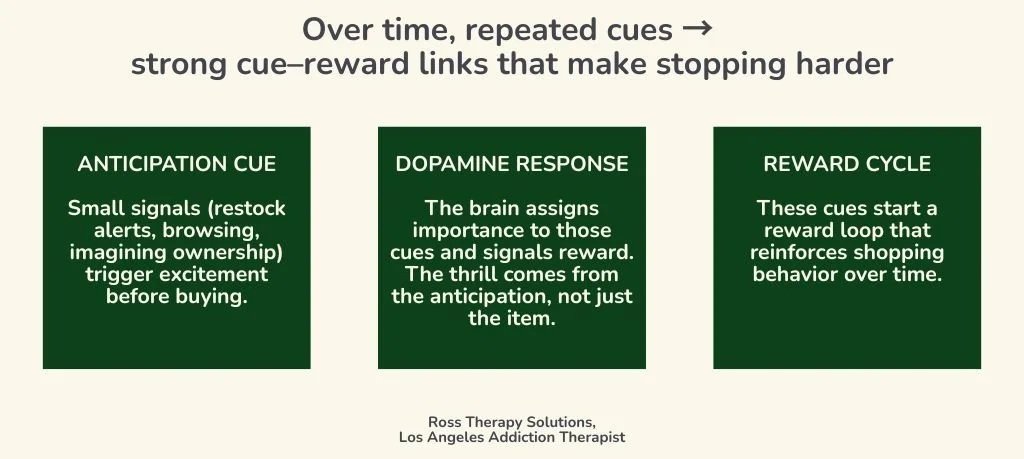
If shopping is hard to stop, it may be because the brain has formed a strong connection between shopping cues and reward (NIH, Archives of Clinical Psychiatry, Science).
OCD and Compulsive Buying
Technically, Compulsive Buying-Shopping Disorder is not classified as a true form of OCD. But it can share some overlapping features.
Both OCD and CBSD can involve strong internal urges, discomfort, and a nagging sense that something is “off.” This tension can motivate a person to act in order to feel relief.
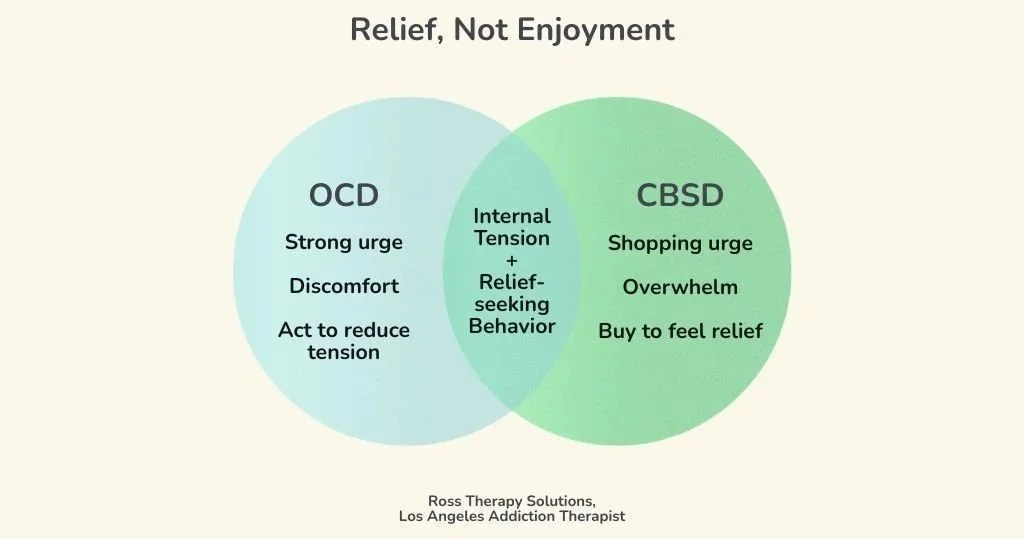
In compulsive buying, shopping can be a way to reduce overwhelm and briefly feel settled again. The focus is less on enjoyment, and more on escaping the discomfort.
With repetition, this pattern can become automatic. A person might buy things they don’t really want, partly because the behavior has become tied to relief (Front. Psychiatry).
The Role of Impulse Control in CBSD
In simple terms, impulse control is what decides whether an urge turns into action. When shopping addiction is rooted in impulse control, an individual’s “go” signals can overpower the “stop” signals. In shopping contexts, the “go” signals are impulses that turn into purchasing behavior.
When a shopping trigger appears, the “go” system gives it a high priority. When we are dealing with other emotions, like stress or loneliness, the urge can feel even stronger.
The “stop” system may engage too late or stronger immediate “go” signals can override it.
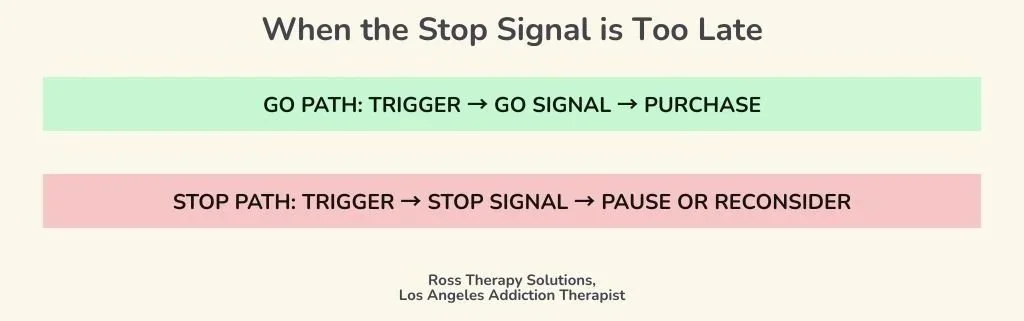
The repeated impulse responses make the connection between triggers and buying stronger as it’s reinforced. This can mean the behavior becomes a habit.
Troubles with impulse control can happen separately from reward-based urges or anxiety-relief urges.
However, in shopping disorders, a reduced impulse control can increase the likelihood that both reward-driven urges and relief-driven urges turn into purchasing behavior. This can lead to both compulsive and addiction-related cycles (Archives of Clinical Psychiatry, Frontiers in Psychiatry).
Why therapy helps break the cycle of shopping addiction
Working with a qualified therapist who has experience with addiction can help you identify triggers, build alternative coping skills, and address any self-esteem issues that may be feeding the cycle.
If you notice that shopping actively interferes with your daily life, emotional well-being, or finances, therapy can help you sustain cutting back on shopping.
When I work with clients with a shopping compulsion, we don’t focus on “trying harder to stop.” Instead, we explore what the shopping compulsion is a coping mechanism for, and work through the emotional and situational triggers that keep the cycle going.
If you’re ready to move past the cravings to buy, I’m available to help.
I specialize in addiction, along with depression and trauma. In recent years, I worked as a primary therapist and Clinical Director at an addiction treatment center, and was a supervisor for an addiction recovery group.
I utilize a direct, yet compassionate approach to help guide people like you to find solution oriented goals, so you can obtain healing and transformation.
